
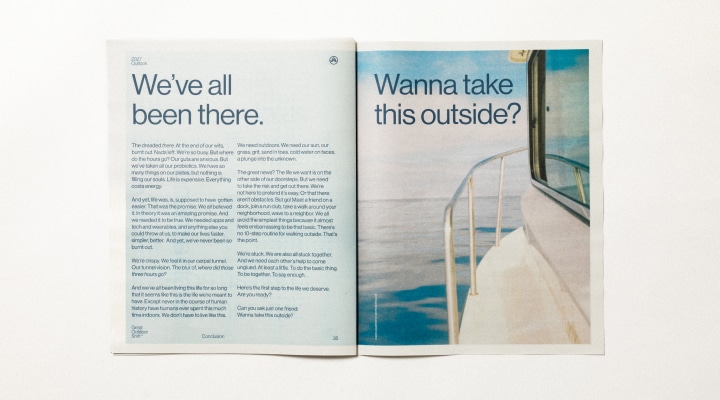
Boatsetter’s latest report reveals a growing urgency to get outside, disconnect from screens, and rediscover the power of shared experiences.
Boatsetter’s inaugural Great Outdoor Shift report revealed creeping angst and a growing desire to trade screens and toward real-world experiences. Now, the Great Outdoor Shift 2.0: 2027 Outlook shows that the movement is gaining momentum.
Through a new national survey of U.S. adults and conversations with outdoor enthusiasts, creators, and Boatsetter Owners, the findings reveal three defining shifts: an urgent need to get outside, a rejection of constant optimization, and a renewed desire to experience life together. View the full report.
Key Takeaways: The Great Outdoor Shift 2.0
- 89% of respondents report feeling burned out.
- 77% have already reduced screen time and social media use.
- 82% plan to spend more on outdoor or water activities in 2027.
- 84% say the outdoors is important for their mental health.
- 63% would trade screen time for time on or near the water.
- Time on the water with friends remains the #1 experience people want more of.
1. Outside Is Urgent: We’re Tired of Being Bad Tired
We’ve become remarkably good at staying inside. We work from home, socialize through screens, order everything to our doors, and unwind by scrolling through other people’s lives. Technology has made almost everything more convenient, but convenience hasn’t necessarily made us happier.

According to Boatsetter’s latest survey, 89% of respondents are burned out, while 67% use wearable technology to manage their sleep and stress.
And despite all that effort, the results aren’t exactly inspiring.
Nearly half of respondents (45%) spent more than $1,000 on wellness, yet only 51% were satisfied with the results.
Meanwhile, 78% are consistently surprised by their weekly screen-time reports, and 60% have considered deleting social media or taking more drastic steps to disconnect from their phones.

The disconnect is becoming impossible to ignore. We’re spending more time, money, and energy trying to feel good, while overlooking one of the simplest ways to actually experience it.
Getting outside.
But the shift isn’t just about recognizing the problem. People are increasingly ready to change their behavior.
Seventy percent would rather spend $150 a month on outdoor experiences than maintain a gym membership. And 82% plan to spend more on outdoor or water activities in 2027.
The message is clear: People don’t need another way to measure their well-being. They need more opportunities to experience it.
2. Optimism Over Optimization: Real Life Is Making a Comeback
For years, the promise of technology has been that less effort equals a better life.
But something interesting is happening. People are actively seeking out experiences that require more of them, not less: Learning to sail. Trying fishing for the first time. Joining a paddle boarding group. Making plans with friends that require everyone to actually show up.
New to boating? Find captained charters near you - no experience or license needed.
Browse ChartersThese activities aren’t necessarily convenient, predictable, or optimized. Increasingly, that’s the appeal.
Comparing Boatsetter’s 2025 and 2026 surveys reveals just how quickly attitudes are changing:
- A 60% increase in respondents who want to spend significantly more on outdoor or water activities.
- A 64% increase in respondents who tried fishing or paddlesport groups.
- A 36% increase in respondents who reported significantly reducing their screen time.

These directional year-over-year shifts suggest people aren’t just dreaming about spending more time outdoors. They’re beginning to make it happen and the benefits go beyond physical activity.
Eighty-four percent of respondents say spending time outdoors is important for their mental health, while 63% would trade screen time for time on or near the water.

Clay Cowart, host and producer of Life by the Bow, describes the difference: “There’s something about being out on the water that allows you to disconnect from the everyday stresses of life.” He explains that even after a physically demanding day, he returns feeling mentally refreshed.
It’s a different kind of tired. Good tired. The kind that comes from doing something rather than consuming something. From being fully immersed in an experience instead of watching one unfold on a screen.
Perhaps that’s why the three things respondents say require effort but make them feel good are so refreshingly simple: making plans with friends and family, going outside and moving their bodies, and learning something new.
No elaborate wellness routine required.
3. All Together Now: Connection Is Becoming Countercultural
There’s another shift happening alongside our desire to spend more time outdoors. We’re remembering how good it feels to do things together. In a world where almost everything can be experienced individually, from entertainment to exercise to shopping, shared experiences are becoming more meaningful.
Boatsetter’s research found that the top reasons people join outdoor groups are to learn something new, meet people outside of dating apps, and spend quality time with friends and family.

It’s a move away from passive connection and toward the kind that happens naturally when people share an experience. And there’s one activity that continues to stand out.
For the second year, “time on the water with friends” ranks as the #1 experience respondents want more of.
A day on the water creates the space for the moments that don’t always happen in everyday life. The conversation that lasts longer than expected. The friend who catches their first fish. The group that learns to sail together. The collective excitement of someone finally standing up on a wakeboard.
These are the moments that bring people closer, precisely because they can’t be replicated through a screen.
Every boat on Boatsetter comes with $1M liability coverage. Rent with confidence.
Find a BoatHannah Miller, Boatsetter Owner-Operator of the schooner Bonnie Lynn, sees the transformation firsthand: “While people are onboard they change.” She describes guests arriving distracted or stressed, only to visibly relax as the experience unfolds. When the sailboat’s engine turns off, the difference becomes even more noticeable.
For Siddiq Cornish, founder of Pacific Town Club, the reward is watching people discover what they’re capable of through shared outdoor experiences. First-time anglers become confident enough to hold up their catch. Beginners develop new skills. People leave feeling empowered and rejuvenated.
It’s a reminder that getting outside isn’t simply about escaping our everyday lives. It’s about finding new ways to participate in them, together.
Why the Water Matters More Than Ever
Across both years of Boatsetter’s research, water-based experiences have emerged as a powerful expression of the Great Outdoor Shift. And it’s not difficult to see why.
On the water, the usual distractions lose their grip. The environment asks for attention. The experience unfolds at its own pace. The people you’re with become the center of the day.
Whether it’s an afternoon fishing, a sunset sail, or a day exploring a new coastline with friends, time on the water offers something increasingly rare: an opportunity to be completely present.
You don’t need to track it, optimize it, or turn it into content for it to count. You simply need to be there. As more people look for ways to replace screen time with experiences, the water offers a natural place to start.
The Bottom Line: The Only Way Forward Is Outside
The Great Outdoor Shift isn’t about rejecting technology or abandoning modern life. It’s about recognizing what technology can’t replace. The satisfaction of learning something difficult. The freedom of spending a day without checking the time. The unexpected conversations, shared discoveries, and memories that happen when we make the effort to show up.
The findings from Great Outdoor Shift 2.0 suggest we’re moving beyond simply wanting these experiences. We’re increasingly making room for them.The good news? Getting started doesn’t require a complete lifestyle overhaul.
Call a friend. Make a plan. Try something new. Spend an afternoon outside. Get on the water.
The life we’re looking for might be a lot closer than we think.
Wanna take this outside? Explore boats and on-water experiences with Boatsetter.

Methodology
The Great Outdoor Shift 2.0: 2027 Outlook is based on a national online survey of 1,038 U.S. adults conducted by Boatsetter in 2026. The survey explored attitudes toward outdoor time, wellness, screen use, social connection, and water-based activities.
Year-over-year comparisons reference Boatsetter’s December 2025 survey (n=834) and September 2026 survey (n=1,034). These surveys were unweighted, and changes should be interpreted as directional rather than nationally representative trends.
Source: Boatsetter, Great Outdoor Shift 2.0: 2027 Outlook.

Boatsetter empowers people to explore with confidence by showing them a world of possibility on the water. Rent a boat, list your boat, or become a Boatsetter captain today.
Your perfect day on the water is a few clicks away. Browse boats near you.
Find a Boat


