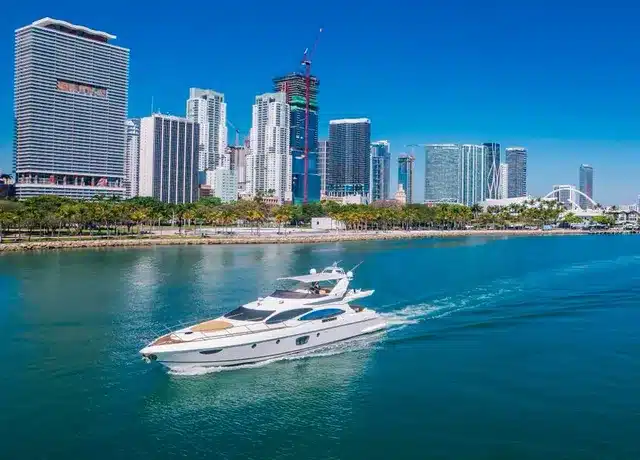
Miami’s warm waters and year-round boating season make it one of the most popular destinations for water recreation in the country. But navigating Biscayne Bay safely requires understanding Florida regulations, proper certification, required equipment, and local waterway rules—knowledge that protects both you and everyone on the water.
Key Takeaways
- Florida requires anyone born on or after January 1, 1988 to carry a Boating Safety Education ID Card while operating a motorized vessel, and the card never expires.
- Manatee protection zones throughout Biscayne Bay enforce strict idle-speed limits year-round with fines up to $500 per violation, and FWC officers actively patrol these areas.
- Every boat rental on Boatsetter includes $1 million in automatic liability coverage, eliminating the need to verify separate insurance before departure.
- Essential safety equipment—life jackets, fire extinguishers, kill switch lanyards, and visual distress signals—is federally and state-mandated, and Florida Marine Patrol actively enforces compliance.
- Hiring a captained charter removes all licensing, equipment, and local-knowledge concerns, making it the safest entry point for first-time boaters in Miami.
Do you need a boating license in Miami?
Florida doesn’t issue a traditional boating license the way states issue driver’s licenses. What it does require is a Florida Boating Safety Education ID Card, and whether you need one depends on when you were born. The Florida Fish and Wildlife Conservation Commission (FWC) administers the requirement, and enforcement on Miami’s waterways is active year-round.
The rule is straightforward: anyone born on or after January 1, 1988 must complete an approved boating safety course and carry their Boating Safety Education ID Card while operating a motorized vessel. That card doesn’t expire, and it’s valid anywhere in Florida. If you were born before that date, you’re technically exempt—but completing a course is still a smart move given how busy Biscayne Bay can get on a weekend afternoon.
| Birth Date | Florida Boating Safety Education ID Required? | How to Comply |
|---|---|---|
| Before Jan 1, 1988 | No | Voluntary; strongly recommended |
| Jan 1, 1988 or later | Yes | Complete an FWC-approved course; carry card on board |
| Any age (rental operators) | Varies by rental agreement | Confirm requirements with owner before departure |
| Under 14 | Cannot operate alone | Must be supervised by someone 18+ with proper certification |
| 14–15 | Yes | Must also be supervised by someone 18+ |
Approved courses are available online through the Florida Fish and Wildlife Conservation Commission and typically take four to six hours to complete. The FWC also offers in-person courses through Miami-Dade County. Once you pass the exam, your card arrives in the mail within a few weeks—though the FWC issues a temporary certificate you can carry in the meantime (Florida FWC).
Essential safety equipment for Miami boating
Federal and Florida law both specify what must be on board before you leave the dock. Skipping any of these items isn’t just a safety risk—it’s a fineable offense, and Florida Marine Patrol officers actively check boats on Biscayne Bay.
Life jackets and personal flotation devices
Every person on board must have access to a properly fitting, Coast Guard-approved life jacket (PFD). Children under 6 must wear one at all times while the vessel is underway. Type III PFDs work well for recreational boating in calm conditions; Type II or Type V may be required in rougher offshore water. A throwable Type IV device—a ring buoy or seat cushion—is also required on boats 16 feet and longer (USCG (eCFR)).
Navigation and signaling equipment
- Navigation lights: Required when operating between sunset and sunrise, or in restricted visibility. Running lights must be Coast Guard-compliant for your boat’s length and type.
- Sound-producing device: A horn or whistle is required on all boats. Boats 39 feet or longer must carry an electric or mechanical horn.
- Visual distress signals: Required on all boats operating on coastal waters, which includes Biscayne Bay. Day signals (orange flag), night signals (electric distress light), or combination flares all qualify.
Fire safety and emergency gear
- Fire extinguisher: Required on any enclosed motorized boat. Boats under 26 feet need at least one B-1 extinguisher; larger boats need more. Check the gauge before every trip—a discharged extinguisher is useless.
- Kill switch lanyard: Florida law requires operators of boats under 26 feet with engines capable of 115 lbs of thrust or more to use an engine cut-off switch while underway. Clip it to your wrist or PFD before you leave the dock.
- Backfire flame arrestor: Required on gasoline-powered inboard engines.
- Ventilation system: Required on boats with enclosed fuel or engine compartments.
A complete boat safety equipment list is worth reviewing before any rental or owned-boat departure—the specifics vary by vessel length and type, and it’s easy to miss something.
Miami waterway regulations and no-wake zones
Biscayne Bay has its own set of rules layered on top of Florida’s general boating law. Miami-Dade County and the FWC enforce both, and ignorance of local rules won’t get you out of a fine. The areas that catch most visitors off guard are the manatee protection zones and the posted speed restrictions near residential canals.
New to boating? Find captained charters near you - no experience or license needed.
Browse Charters| Area or Rule Type | Speed Limit / Restriction | Reason / Penalty |
|---|---|---|
| Manatee protection zones (seasonal) | Idle speed or slow speed; varies by zone | Manatee habitat; fines up to $500 per violation (Florida FWC) |
| No-wake zones near marinas and docks | Idle speed; no wake | Vessel and dock protection; fines vary by county |
| Residential canals (Miami-Dade) | Idle speed in most posted areas | Erosion, dock damage, and resident safety |
| Biscayne Bay open water | 30 mph in most areas; posted zones differ | General navigation safety |
| Near swimmers and dive flags | 300 feet offshore, 100 feet in inland waters | Diver safety; mandatory slow speed within those distances (Florida Senate) |
| Federal channels and shipping lanes | Stay clear; yield to commercial traffic | Collision risk; federal enforcement |
Manatee zones are particularly important in Miami. The FWC designates seasonal and year-round slow-speed zones throughout Biscayne Bay and the surrounding canal systems. Running through a manatee zone at speed doesn’t just risk harming wildlife—it draws the attention of FWC officers who patrol these areas regularly. Boating safety in Miami means treating manatee zones as seriously as speed limits on the highway.
The Miami-Dade County marine patrol also enforces local ordinances that don’t appear in state law, including restrictions on anchoring in certain areas and rules around noise levels after dark. If you’re renting a boat and heading out on Biscayne Bay for the first time, a quick conversation with your boat owner about local hotspots and restricted zones is worth more than any map.
Boating insurance in Miami: what you should know
Florida doesn’t legally require boat owners to carry insurance the way it requires car insurance, but operating an uninsured vessel on Miami’s busy waterways is a significant financial risk. A collision in a crowded marina or a liability claim from an injured passenger can easily exceed $100,000.
Here’s what matters for anyone boating in Miami, whether you own or rent:
- Liability coverage pays for bodily injury and property damage you cause to others. This is the most critical coverage for any boater. Standard policies typically offer $100,000 to $300,000 in liability limits; higher limits make sense in Miami’s high-traffic waterways.
- Physical damage coverage protects your own vessel from collision, sinking, fire, and theft. For owners, this is the equivalent of comprehensive and collision on an auto policy.
- Uninsured boater coverage protects you if you’re hit by someone without insurance—more common than you’d expect.
- Medical payments coverage covers injuries to you and your passengers regardless of fault.
If you’re renting through Boatsetter, the coverage question is already answered. Every rental on the platform includes $1 million in liability coverage automatically, protecting both the renter and the boat owner. You don’t need to purchase a separate policy or verify that the owner carries adequate insurance before you board. That built-in boating liability coverage is one of the clearest practical advantages of booking through a platform rather than a private arrangement.
Boat owners who list on Boatsetter also benefit from this protection. Their personal boat insurance policy typically excludes commercial rentals, so the platform’s coverage fills that gap.
Why renting with a captain is the safest choice
If you’re new to boating, or new to Miami’s specific waterways, booking a captained charter removes the most common sources of anxiety in one step. Here’s what you get with a Boatsetter captain:
- No licensing concerns. The captain handles all certification requirements. You don’t need a Florida Boating Safety Education ID to be a passenger.
- Local expertise. A Miami captain knows which channels to avoid at low tide, where the manatee zones are, how afternoon thunderstorms build over the Everglades, and which anchorages are worth the trip. That knowledge takes years to accumulate.
- Safety equipment verification. The captain is responsible for ensuring the vessel meets all federal and Florida safety requirements before departure. You don’t have to run a pre-departure checklist you’re not sure about.
- Emergency response. An experienced captain knows what to do if an engine fails, weather turns, or someone gets hurt. That’s not a skill you develop on a first trip.
- Liability coverage. Boatsetter’s $1 million liability coverage applies to captained charters too, so you’re protected regardless of how the day unfolds.
Captain services in Miami run the range from half-day Biscayne Bay tours to full-day offshore fishing charters. Rates vary by boat type and duration, but for a first-time renter or a group that wants to focus on the experience rather than the operation, the cost is straightforward to justify.
Every boat on Boatsetter comes with $1M liability coverage. Rent with confidence.
Find a BoatRenting a boat safely without a captain
If you do have your Florida Boating Safety Education ID and want to take the helm yourself, a self-drive rental through Boatsetter is a solid option—as long as you approach it methodically.
Before you leave the dock:
- Confirm you meet the certification requirement. If you were born on or after January 1, 1988, carry your ID card. The boat owner may ask to see it.
- Do a full walkthrough with the owner. Ask them to show you every safety item on board—where the fire extinguisher is, how the kill switch works, where the flares are stored. Don’t skip this step even if you’ve rented before.
- Check the weather. Miami’s afternoon thunderstorms develop fast, especially in summer. Check the National Weather Service forecast for Biscayne Bay specifically, not just the general Miami area. Sailing weather safety resources can help you read marine forecasts accurately.
- Review the boat’s controls before you move. Every boat handles differently. Spend five minutes at the dock understanding the throttle response, steering sensitivity, and any quirks the owner mentions.
- Know the float plan basics. Tell someone on shore where you’re going and when you expect to return. If something goes wrong, that information gets help to you faster.
Once underway:
- Respect posted speed limits and no-wake zones immediately—don’t wait until you see a sign to slow down near marinas.
- Keep a 360-degree watch, especially in the channels around Coconut Grove and Key Biscayne where jet skis, paddleboards, and commercial traffic mix.
- Never anchor in a channel or fairway, even briefly.
- If a storm is building to the west, head in early. Biscayne Bay is shallow and the chop builds quickly in a squall.
Boat rental safety on unfamiliar water comes down to preparation and humility. The owners on Boatsetter know their boats and their local waters—treating that conversation as the valuable resource it is makes every trip better.
Getting certified and next steps for Miami boating
The fastest path to a Florida Boating Safety Education ID is the FWC’s approved online course, available through providers like BoatUS Foundation and Boat-Ed. Both offer the free state course that satisfies Florida’s requirement. You complete the material at your own pace, pass a proctored exam, and receive your card by mail. The FWC also accepts in-person courses offered through Miami-Dade County parks and recreation programs for those who prefer a classroom setting.
If you’re not yet ready to operate a boat yourself, a captained charter on Boatsetter gives you the full Miami boating experience—Biscayne Bay, the sandbar at Nixon, the views of the Miami skyline from the water—without any of the certification or equipment burden. It’s also a genuinely useful way to learn the waterway before you take the helm yourself on a future trip.
Boater safety courses by state vary in structure, but Florida’s is among the more thorough ones, covering navigation rules, emergency procedures, and the specific regulations that apply to South Florida waters. Completing it before your first time on Biscayne Bay isn’t just a legal checkbox—it’s the difference between a confident day on the water and one spent hoping you’re doing everything right.

Boatsetter empowers people to explore with confidence by showing them a world of possibility on the water. Rent a boat, list your boat, or become a Boatsetter captain today.
Frequently Asked Questions
Do I need a boating license to operate a boat in Miami?
Florida doesn't issue a traditional boating license, but anyone born on or after January 1, 1988 must carry a Florida Boating Safety Education ID Card while operating a motorized vessel. The card never expires and is valid anywhere in Florida. If you were born before 1988, you're exempt but completing a safety course is still recommended given Biscayne Bay's traffic.
What safety equipment is required on boats in Florida?
All boats must carry Coast Guard-approved life jackets for every person on board, navigation lights for night operation, a sound-producing device, visual distress signals, and a fire extinguisher if the boat is motorized and enclosed. Boats under 26 feet with engines of 115 lbs thrust or more also require a kill switch lanyard. Florida Marine Patrol actively enforces these requirements on Biscayne Bay.
What are the no-wake zones and speed limits in Miami?
Biscayne Bay has year-round manatee protection zones with idle-speed or slow-speed limits; violations carry fines up to $500. Residential canals and areas near marinas also enforce idle speed. Most open Biscayne Bay water allows 30 mph unless posted otherwise. FWC officers regularly patrol these areas, so treating manatee zones as seriously as highway speed limits is essential.
Is boating insurance required in Miami?
Florida doesn't legally require boat insurance like it does for cars, but it's a significant financial risk to operate uninsured on Biscayne Bay. Every boat rental on Boatsetter includes $1 million in automatic liability coverage, eliminating the need to verify separate insurance before departure. For boat owners, liability coverage typically protects against bodily injury and property damage claims.
Your perfect day on the water is a few clicks away. Browse boats near you.
Find a Boat


