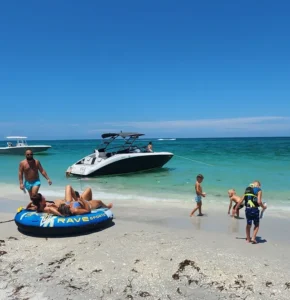
Cutting screen time rarely works as a subtraction problem. It works when something better is already on the calendar, and outdoor hobbies win because they put your hands, your friends, and your attention somewhere a phone can’t follow.
Boatsetter’s Great Outdoor Shift 2.0 survey of 1,038 US adults found that 89% report feeling burned out, and 60% have considered steps to disconnect: deleting social, reducing screentime for time spend outside, or Bricking their phone.
Key Takeaways
- Replacing screen time works better than cutting it, since an empty 9 p.m. slot just pulls the phone back by Wednesday.
- American adults average over four hours of daily phone use, and most of it is unplanned leftover time, not a deliberate choice.
- Any replacement activity needs under 10 minutes of setup time, or it will consistently lose to a phone that’s already in hand.
- Boating scores highest on phone displacement because fading signal, wet hands, and assigned crew jobs remove the option to scroll entirely.
- A Boatsetter survey found 63% of adults would trade screen time for water time, and 89% report feeling burned out overall.
How-to swap scrolling for outside
Step 1: Pick one window, not your whole day
Choose the single scroll window with the most time in it that you can realistically fill. For most working adults that’s Saturday or Sunday morning, not a weeknight. Weeknight evenings are defended by fatigue, dinner, and kids. Weekend mornings are defended by nothing but inertia.
Commit to that one window for four weeks. Leave every other window alone. You are not quitting screens. You are trading a specific block.
Step 2: Cut the setup time to under 10 minutes
Friction decides this. If your kayak lives under a tarp behind the shed and the paddle is in the basement, you’ll go twice a season. If the bag is packed by the door, you’ll go weekly.
Do a dry run of the swap and time it. Anything over 10 minutes between “I want to go” and “I’m moving” needs to be fixed: pre-pack a bag, keep shoes in the car, book the thing in advance so the decision is already made. Renting solves most of this by default. Someone else handles the trailer, the maintenance, and the fuel, and you show up. That’s also why the math on boat rental cost vs gym membership surprises people. A gym costs $40 to $60 a month whether you go or not, and a shared half-day on a rented boat is a single, scheduled event you actually attend.
Step 3: Attach another person to the plan
A plan with one name on it is a suggestion. A plan with two names on it is an obligation, and obligation is the only thing that reliably beats a couch.
Text someone specific with a date and a time, not an idea. “Saturday 9, you in?” works. “We should do something outdoors sometime” does not. Group plans also raise the phone-free ceiling, which is why fun group activities for friends outdoors tend to stick longer than solo hobbies.
Step 4: Put it on repeat at the same time each week
Make it an unmoving calendar block with a recurring invite. Same day, same hour. The point is to remove the weekly decision, because every decision is a chance to default back to the phone.
New to boating? Find captained charters near you - no experience or license needed.
Browse ChartersRituals also gather momentum. The first Saturday is awkward and logistical. By the fourth, people are texting you about it on Thursday.
Step 5: Review after four weeks and adjust
At week four, open the screen time report again and compare the same window. You’re looking for one thing: did the targeted block actually drop? If it did and the hours leaked somewhere else, you still won, because the replacement is holding. If the block didn’t drop, the activity probably failed the 10-minute test or the social test. Change the activity, not the goal.
Outdoor hobbies ranked by how well they displace screens
Not all offline hobbies block a phone equally. Gardening is restorative, but you can absolutely garden with a podcast playing and a phone in your back pocket, checked every ten minutes. The ranking below weighs how physically hard each activity makes it to pick up a device.
| Hobby | Startup cost | Time to first try | Social factor | Phone-free rating |
|---|---|---|---|---|
| Walking or hiking | $0-120 (shoes) | Same day | Low to medium | 2/5, phone stays in hand |
| Gardening | $50-200 | A weekend | Low | 2/5, easy to scroll between tasks |
| Birdwatching | $100-250 (binoculars) | Same day | Medium | 3/5, but apps are part of it |
| Rock climbing | $75-150 (gym intro) | One session | High | 4/5, hands are busy and chalky |
| Fishing from shore | $60-150 | Same day | Medium | 4/5, idle hands between bites |
| Kayaking | $45-80 rental/day | Same day | Medium | 4/5, wet hands, no dry pocket |
| A day on a boat | $200-700 shared/day | Book in a week | Very high | 5/5, weak signal, crew duties, shared schedule |
Costs reflect typical US rental and entry-level gear pricing and vary by region and season.
Two patterns show up in that table. Water-based activities score highest on phone displacement, and the activities with the highest social factor are the ones people repeat. Rock climbing is the only land hobby that scores near the top, and for the same structural reason as boating: your hands are committed and someone else is depending on you.
Why time on the water holds attention longest
A boat is one of the few places where the phone stops being an option instead of a temptation. That difference matters more than any app blocker.
- Signal fades. A few miles offshore or deep into a bay, service drops to nothing. The decision gets made for you.
- Hands are wet or working. Lines, rods, coolers, and a swim ladder leave no dry, free hand.
- Everyone has a job. Someone watches for traffic, someone handles the dock lines, someone runs the music and the sunscreen.
- Drop risk is real. People do not casually scroll over 30 feet of water.
- The view resets attention. Open horizon and moving water are exactly the low-demand, high-interest stimuli that let a tired brain recover mental clarity, which is the core of the research on the mental health benefits of being on the water (University of Washington).
The survey data lines up with that. In the Great Outdoor Shift 2.0 report, 63% of US adults said they would trade screen time for time on the water, 82% plan to spend more on outdoor or water activities in 2027, and “time on the water with friends” ranked as the number one desired experience for the second year running (Skift). People are not asking for a wilderness retreat. They’re asking for four hours, a boat, and the people they already like.
If a full day feels like a lot, the same logic scales down. Most of the best digital detox weekend ideas are just one anchored outdoor block on Saturday plus an unhurried Sunday, not a silent cabin in the woods.
Every boat on Boatsetter comes with $1M liability coverage. Rent with confidence.
Find a BoatGetting kids and family off screens without a ban
Confiscating a tablet creates a negotiation. Offering something more interesting ends one. The approach that works with kids is the same five-step system, with one adjustment: you go first.
- Lead with the better option, not the ban. Announce the fishing trip on Thursday. Don’t announce the screen limit at all.
- Join for the first ten minutes. Most kids stall at the awkward start of an activity, not the middle. Bait the first hook, paddle the first hundred yards, then step back.
- Give it a shared goal. Catch three fish, find five bird species, reach the sandbar. A target beats “go play outside.”
- Make it the same day every week. Kids defend rituals harder than adults do. Once Saturday is boat day, they’ll remind you.
- Let them own one job. Chart reading, coiling the bow line, running the cooler. Responsibility is the strongest phone repellent there is.
For a first outing with kids, pick calm, shallow water and short runs. Many of the best fishing spots for beginners are protected bays, jetties, and lake coves where the ride out takes ten minutes and the action starts quickly. The point of family bonding activities on the water is sustained attention, and attention collapses on a 40-minute transit with nothing to do.
Pediatric guidance has moved away from strict hour counts toward replacing screen time with sleep, physical activity, and face-to-face interaction, which is exactly what a half-day outdoors delivers in a single block (AAP).
Plan your first screen-free day on the water
Here’s what a realistic first swap looks like. Four and a half hours, one Saturday, no experience required.
| Time | What’s happening | Phone status |
|---|---|---|
| 8:30 a.m. | Coffee, cooler, sunscreen, towels into the car | On, for the map |
| 9:15 a.m. | Meet the captain or owner at the dock, safety briefing | Photos only |
| 9:45 a.m. | Run out to the first stop, 20 minutes | In a dry bag |
| 10:15 a.m. | Anchor, swim, fish, float | No signal |
| 12:30 p.m. | Raft up or beach for lunch | Still in the bag |
| 1:30 p.m. | Slow run back, everyone sunburned and quiet | Off |
| 2:00 p.m. | Dock, unload, make next week’s plan out loud | Back on |
Bring more water than you think you need, a dry bag, polarized sunglasses, a hat that stays on at 25 mph, and a towel per person. Skip the bluetooth speaker argument by assigning one person to music before you leave the dock.
If nobody in the group has driven a boat, book a captained trip. Boat charters with no experience necessary come with a licensed captain who handles the helm, the route, and the docking, so the group’s only job is showing up. That removes the last real piece of friction for a first-timer. If the day sticks and you want to go deeper, learning to sail for beginners is the natural next step, and most coastal areas have weekend intro courses that get you on the tiller within an hour.
Book it for a specific Saturday in the next three weeks. A date on the calendar is the only part of this system that can’t be skipped.

Boatsetter empowers people to explore with confidence by showing them a world of possibility on the water. Rent a boat, list your boat, or become a Boatsetter captain today.
Frequently Asked Questions
What hobbies are best for reducing screen time?
Water-based activities work best because they make scrolling physically difficult, not just undesirable. A day on a boat scores highest since fading signal, wet hands, and assigned crew jobs remove the option entirely, followed by kayaking and fishing from shore. Rock climbing is the top land-based option for the same reason: busy hands and shared responsibility.
How long should offline activities replace screen time daily?
Aim to replace about six hours a week rather than trying to eliminate screens daily. That target lines up with wellbeing research showing a meaningful jump in self-reported wellbeing at around 120 minutes of outdoor time per week. A practical way to hit it is one focused Saturday morning block instead of scattered small swaps.
How can parents encourage children to choose offline hobbies?
Lead with a specific plan instead of a screen ban, join for the first ten minutes since kids stall at the awkward start, and give the outing a concrete shared goal like catching three fish. Repeating it on the same day each week and letting the child own one job, such as coiling the line, makes the ritual stick.
Can outdoor activities really compete with screen entertainment?
Yes, but only if the activity takes under 10 minutes of setup from decision to moving, since anything slower consistently loses to a phone already in hand. A Boatsetter survey found 63% of adults would trade screen time for water time, which suggests the appetite exists once the friction is removed.
Your perfect day on the water is a few clicks away. Browse boats near you.
Find a Boat