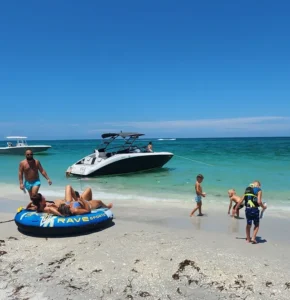
Water does something measurable to a stressed brain. Breathing slows, attention loosens, and the mental noise drops within minutes of leaving the dock. Here is what the research actually shows, what boaters report firsthand, and how to turn it into a day you can book this month.
Key Takeaways
- A University of Michigan study found a significant cortisol drop after just 20 to 30 minutes of nature contact, a window easily covered by a short boat trip.
- Attention restoration theory explains the calm: watching a horizon triggers soft fascination, letting the brain’s directed-attention system rest instead of burning through micro-decisions like scrolling does.
- Boatsetter’s Great Outdoor Shift 2.0 survey found 89% of 1,038 U.S. adults reported feeling burned out, and time on the water with friends ranked as the #1 most desired experience for the second year running.
- Studies on blue space show associations with lower psychological distress that hold even after controlling for green space in the same neighborhoods, meaning water offers something parks alone don’t.
- Boaters commonly describe a stress-drop sequence where breathing syncs with the boat by minute 10 to 25 and the mental ‘what am I forgetting’ loop quiets by minute 25 to 60.
- Learning hands-on skills like docking or anchoring produces a flow state that correlates with improved mood, and four to six people is described as the sweet spot crew size for real conversation on most 22- to 26-foot boats.
What happens to your brain on the water
The shift starts before the engine is up to cruising speed. Your eyes stop darting between small, high-contrast objects and settle on a horizon line. Your inner ear registers a slow, repeating motion instead of the hard stillness of a desk chair. Your ears pick up broadband noise, water against hull, wind, engine hum, rather than the sharp pings that pull focus.
Psychologists call the attention state that follows soft fascination: the environment holds your attention effortlessly, so the directed-attention system you burn through all day gets a rest. That is the core of attention restoration theory, developed by Rachel and Stephen Kaplan at the University of Michigan (USDA Forest Service). Scrolling does not do this. Scrolling demands constant micro-decisions, which is why an hour on your phone leaves you more depleted than an hour staring at a wake.
Marine biologist Wallace J. Nichols popularized the term Blue Mind for this state: a mildly meditative calm triggered by being in, on, or near water (Wallace J. Nichols). The term gets used loosely, but the underlying measurements are real. Studies using cortisol samples and heart rate variability have found contact with natural settings lowers physiological stress markers, with one University of Michigan study finding a significant cortisol drop after just 20 to 30 minutes of nature contact (University of Michigan).
Practically, boaters tend to describe the same sequence:
- Minutes 0 to 10: still mentally at work, checking the phone, scanning the dock.
- Minutes 10 to 25: breathing drops into rhythm with the boat; conversation slows down.
- Minutes 25 to 60: the “what am I forgetting” loop goes quiet; time estimation gets fuzzy.
- After the trip: a carryover calm that most people report lasting the rest of the day and into the next morning.
Burnout, screens, and the pull toward open water
The science is not new. What changed is how many Americans urgently need it. Boatsetter’s Great Outdoor Shift 2.0 report, a national survey of 1,038 U.S. adults, found a population that is running on empty and knows exactly what it wants as a remedy.
- 89% reported feeling burned out. Not stressed about one deadline, burned out.
- 84% said time outdoors is important to their mental health. That is close to unanimous.
- “Time on the water with friends” ranked as the #1 most desired experience, for the second year running.
- 82% plan to spend more on outdoor or water activities in 2027, which is the rare case of stated intent matching stated need.
Screen load is the other half of the story. The average U.S. adult spends several hours a day on a phone alone, and the fragmented attention that comes with it is exactly the system that soft fascination repairs (Reviews.org). That is why the benefits of unplugging from technology show up fastest in places where unplugging is not a willpower exercise. Three miles offshore, the decision is made for you.
If you want to read the full survey, including what owners and outdoor creators said about disconnecting, the Great Outdoor Shift 2.0 report lays out the numbers in detail.
New to boating? Find captained charters near you - no experience or license needed.
Browse ChartersWhy blue space beats a walk in the park
Most articles on this topic treat all nature as interchangeable. The research does not. Studies on blue space, meaning visible or accessible water, have found associations with lower psychological distress that hold even after controlling for green space in the same neighborhoods (PubMed/NIH). Water is doing something green alone does not.
| Setting | Sensory input | Reported stress effect | Barrier to getting there |
|---|---|---|---|
| Open water on a boat | Motion, broadband sound, unbroken horizon, wind, light reflection | Boaters typically describe the deepest and longest-lasting calm | Needs a booking, a launch point, and a few hours |
| Shoreline or beach walk | Wave sound, horizon, but crowds and traffic noise nearby | Strong, though often interrupted | Low, if you live near a coast or lake |
| City park or green space | Birdsong, shade, visual depth limited by trees and buildings | Measurable but shorter; attention snaps back quickly | Very low |
| Indoor rest at home | Familiar cues, chores in view, household noise | Mild; the to-do list stays visible | None, which is the problem |
| Screen-based downtime | High-contrast, high-frequency, decision-heavy | Often negative; depletes directed attention further | None |
This table compares settings on sensory and practical grounds, not on head-to-head study data; no cited research ranks boating directly against beach walks, parks, or indoor rest. The difference comes down to three things: a boat removes you physically from the environment that caused the stress, water provides continuous motion rather than a static scene, and offshore you lose the two interruptions that break park-bench calm, phone signal and other people’s noise.
Shared boat days and the connection effect
A boat is a small enclosed space with no exits. That sounds like a downside. It is the entire social advantage.
At a restaurant, someone leaves for a call, the check arrives in 90 minutes, and the group scatters. On a boat, the same six people are together for four hours with nowhere to go and nothing competing for attention. Conversation gets longer, slower, and more honest. Loneliness is a documented health risk, and the U.S. Surgeon General’s advisory on social connection put the health impact of chronic isolation in the same category as other major public health concerns (U.S. Surgeon General).
What a boat day with friends gives you that a group text does not:
- Uninterrupted hours. Four hours of shared time without anyone checking out.
- Shared physical tasks. Handing lines, setting an anchor, and passing gear create the low-stakes cooperation that builds trust.
- A natural phone ceiling. Spotty service does the discipline work for you.
- A shared memory anchor. Groups retell boat days for years, which keeps the connection active long after the trip.
If one person in the group has been hard to reach for months, a boat is the invitation that tends to work.
Learning to run a boat builds confidence
The calm is half of it. The other half is competence. Learning a hands-on skill produces flow, a state of absorbed, challenge-matched focus that correlates with improved mood and emotional resilience (NIH/PMC). Operating a boat delivers it reliably, because the feedback is immediate and physical. You either held the line into the slip or you did not.
Every boat on Boatsetter comes with $1M liability coverage. Rent with confidence.
Find a BoatStart with a captained charter
Book a captained boat charter, no experience needed, and spend the first trip watching. A good captain will explain the depth sounder, point out why they are reading the water ahead, and let you take the wheel in open water. You get the mental health benefit with zero planning load, which matters: the stress of docking a strange boat in a crosswind can cancel out the calm you came for.
Move to a small, simple boat
Pontoons and small center consoles are forgiving, slow to react, and easy to read. When you start comparing the best boats for beginners to rent, favor beam over speed. A wide, stable hull makes everything easier, including the part where someone stands up to grab a cooler. Check what your state requires first, since boater education and licensing rules vary and several states tie the requirement to your birth year (USCG Boating).
Add one skill per outing
Do not try to learn everything in a day. One outing: leaving and returning to the slip. Next: anchoring in 12 feet of water with proper scope. Next: reading a chart and planning a route to a sandbar. Skills stack faster this way, and each small success is the part that lifts mood.
How to plan a reset day on the water
Pick the format that matches your goal
| Trip format | Typical length | Best for | Experience needed |
|---|---|---|---|
| Sunset cruise | 2 hours | A quick reset after a brutal week | None, captain included |
| Captained half-day charter | 4 hours | First-timers, mixed groups, anyone who wants zero logistics | None |
| Pontoon day rental | 4 to 8 hours | Families and slow, low-key group days | Basic; state certificate may apply |
| Sailing day trip | 4 to 6 hours | Deep focus and skill learning; the quietest option under way | None with a captain |
| Overnight or weekend charter | 1 to 3 days | A true digital detox weekend getaway | None with a captain |
Set the phone rule before you board
Decide at the dock, not underway. The rule that works: one phone stays on for navigation and emergencies, everyone else’s goes in a dry bag in the console. Pick one designated photo window, 15 minutes at the sandbar, and the rest of the day stays camera-free. Crews that leave the decision until they are underway tend to keep checking anyway, deciding at the dock is what makes the rule stick.
Choose your crew size carefully
Four to six people is the sweet spot for conversation on most 22- to 26-foot boats. Everyone can hear each other, and the group does not split into two. Above eight, a boat day becomes a party, which is great but is a different product than a reset. If the goal is anxiety relief, go small. If it is connection, six.
Book the boat
Search by your nearest launch point and filter for a captain if you have never run a boat. Morning departures are calmer on most lakes and bays, with lighter wind and less traffic, and the light is better. Book the earliest slot you will realistically wake up for, and give yourself four hours rather than two. The research is clear that the effect deepens past the first half hour.

Boatsetter empowers people to explore with confidence by showing them a world of possibility on the water. Rent a boat, list your boat, or become a Boatsetter captain today.
Frequently Asked Questions
Is boating good for mental health?
Yes, a University of Michigan study found a significant cortisol drop after just 20 to 30 minutes of nature contact, a window any short boat trip covers. Boaters also commonly report breathing syncing with the boat within 10 to 25 minutes and the mental 'what am I forgetting' loop quieting by the 25 to 60 minute mark, with calm often carrying into the next day.
What is Blue Mind Theory and boating?
Blue Mind is marine biologist Wallace J. Nichols's term for the mildly meditative calm people experience in, on, or near water. It lines up with real measurements: studies on blue space show associations with lower psychological distress that hold even after accounting for green space in the same neighborhoods, meaning water offers a calming effect that parks alone don't fully replicate.
How does boating reduce stress and anxiety?
It works through several mechanisms at once, soft fascination lets your directed-attention system rest instead of burning through micro-decisions, your heart rate and breathing slow under a parasympathetic shift, and sensory simplification removes notifications, traffic, and overlapping voices. A passenger just sitting still on the bow gets most of these benefits without doing anything athletic.
Does boating improve overall well-being beyond just relaxation?
It does, largely through connection and competence. Time on the water with friends ranked as the #1 most desired experience in Boatsetter's Great Outdoor Shift 2.0 survey of 1,038 U.S. adults, and a boat's uninterrupted hours and shared tasks like anchoring build the kind of trust a group text can't. Learning hands-on skills like docking also produces a flow state linked to improved mood and emotional resilience.
Your perfect day on the water is a few clicks away. Browse boats near you.
Find a Boat