Lake Powell‘s vast, calm waters and consistent conditions make it one of the Southwest’s premier wakesurfing destinations. Whether you’re a beginner learning to pop up or an experienced rider dialing in tricks, this guide covers everything you need to plan a successful wakesurfing trip.
Key Takeaways
- Lake Powell’s canyon walls create naturally glassy water and protected coves ideal for wakesurfing, with 186 miles of shoreline offering uncrowded space to practice.
- Dedicated wakesurf boats with 2,000–3,500 pounds of ballast throw significantly better waves than older inboard ski boats, but entry-level boats work fine for beginners learning to pop up.
- Water temperatures reach 70–80°F from July through August, making extended sessions comfortable without a wetsuit; early June and post-Labor Day offer warmer water with fewer crowds.
- Federal regulations require a dedicated observer watching the surfer or a wide-angle mirror on the boat, and all riders must wear Coast Guard-approved life jackets at all times.
- Bent knees, centered weight, and slacking the rope early to ride the wave pocket ropeless are the fundamentals that separate successful beginner pop-ups from repeated falls.
Why Lake Powell is ideal for wakesurfing
Lake Powell sits inside Glen Canyon National Recreation Area, straddling the Utah-Arizona border, and its geography does something remarkable for water sports: it creates natural protection. The canyon walls that define the lake’s 186 miles of shoreline block wind from most directions, leaving long stretches of glassy water even on afternoons when surrounding desert terrain would be blustery. That flat water is exactly what a wakesurf boat needs to throw a clean, surfable wave.
Beyond the conditions, the sheer size of the lake means you rarely have to share a cove with another boat. On a busy summer weekend at a smaller reservoir, you’d be dodging wakes from every direction. At Powell, you can find a canyon arm with room to run half-mile passes without seeing another boat.
Water depth is another factor. Wakesurfing requires at least 8–10 feet of water under the hull to let the wave form properly without bottom interference (NPS Glen Canyon). Powell’s main channel runs much deeper, and even most canyon arms hold adequate depth throughout peak season.
| Factor | Lake Powell | Why It Matters |
|---|---|---|
| Shoreline | 186 miles | Endless coves to escape boat traffic |
| Canyon wall protection | High on most arms | Reduces wind chop for glassy conditions |
| Water depth (main channel) | 100–300+ feet | Clean wave formation, no bottom interference |
| Water temperature (peak) | 70–80°F (July–Aug) | Comfortable for extended sessions without a wetsuit |
| Boat traffic | Moderate, spread over large area | Easier to find open water than at smaller lakes |
Types of wakesurfing boats to rent
Not every boat creates a surfable wave. Wakesurfing is done at 9–12 mph, close to the boat — typically 6–10 feet off the stern — which means the wave quality depends almost entirely on hull design, weight distribution, and ballast. Outboard and I/O boats are not safe for wakesurfing because their propellers are exposed at the stern; the sport requires an inboard engine with the prop tucked safely under the hull.
Dedicated wakesurf boats
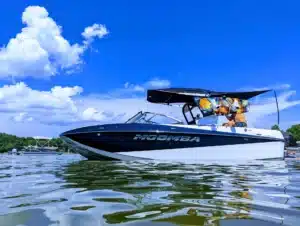
Brands like Malibu, Mastercraft, Nautique, and Centurion build boats specifically for wake sports. A Malibu Wakesetter or Mastercraft X-series comes with factory-installed ballast tanks that can hold 2,000–3,500 pounds of water, plus surf tabs or wake-shaping devices that push the wave to one side of the boat. These systems let the driver dial in wave height, length, and pocket depth from a touchscreen. For experienced riders who want a long, powerful wave to throw airs or ride ropeless, a dedicated wakesurf boat is the right call.
Inboard wake boats
Older inboard ski boats and entry-level wake boats — think a Mastercraft ProStar or a mid-2000s Tige — can produce a rideable wave with aftermarket ballast bags and proper passenger positioning. The wave won’t be as tall or as long as what a modern surf-specific hull generates, but it’s more than adequate for learning the basics. These boats typically rent for less per hour, making them a practical starting point if you’re not sure how much time you’ll spend on the rope.
Ballast systems explained
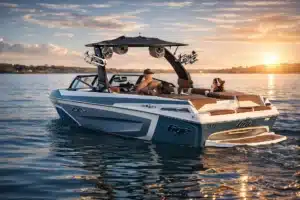
A ballast system is simply a set of tanks or bags that fill with lake water to add weight and push the hull lower in the water. More weight = bigger, steeper wave. Most modern wake boats have a dedicated port-side or starboard-side ballast option so the wave breaks cleanly to one side — the side your surfer rides. When you’re browsing rentals, ask the owner what their total ballast capacity is. A boat with 3,000 pounds of ballast will throw a noticeably better wave than one with 1,200 pounds.
| Boat Type | Wave Quality | Best For | Typical Rental Cost |
|---|---|---|---|
| Dedicated surf boat (e.g., Malibu Wakesetter, Nautique G23) | Excellent — tall, long, shapeable | Intermediate to advanced riders | $150–$300/hr |
| Modern wake boat with factory ballast (e.g., Tige, Centurion) | Very good | Beginners and intermediate riders | $120–$220/hr |
| Inboard ski/wake boat with sac ballast | Good for learning | Beginners on a budget | $80–$150/hr |
| Pontoon or deck boat | Not suitable | N/A | — |
New to boating? Find captained charters near you - no experience or license needed.
Browse ChartersWakesurfing vs. wakeboarding: What’s the difference
These two sports share the same boat and the same water, but they feel completely different once you’re on the surface.
Wakesurfing:
- Rider stays 6–10 feet behind the boat, surfing the wave without being pulled
- Once up, you toss the rope and ride ropeless — the wave carries you
- Boat speed is slow: 9–12 mph
- Board is shorter and thicker, similar to a surfboard
- Lower impact on knees and ankles
- Requires an inboard boat (prop is under the hull)
- Easier to learn for most adults — the slow speed and soft wave are forgiving
Wakeboarding:
- Rider stays on a longer rope (60–75 feet) and rides the wake like a ramp
- Constant rope tension; you use the wake to launch into aerial tricks
- Boat speed is faster: 18–24 mph
- Board is longer and stiffer with bindings, similar to a snowboard
- Higher impact; harder on knees at speed
- Works with inboard or direct-drive boats
- Tricks are more visually dramatic, but the learning curve for jumps is steeper
If your group includes mixed skill levels or kids, wakesurfing’s slower speed and softer falls make it the more accessible starting point. Many renters end up doing both in a single day — switching between the rope and the surf board as riders rotate.
Best times and locations to wakesurf at Lake Powell
Peak season and water temperature
The practical wakesurfing season at Lake Powell runs from late May through early September. Water temperatures in the main channel typically climb to 70°F by late May and peak around 78–82°F in July and August (NPS Glen Canyon). That warmth makes extended sessions comfortable without a full wetsuit — board shorts and a rash guard are enough for most riders in July.
June and September offer a sweet spot: water is still warm, but the crowds thin compared to the July 4th and August rush. If you can schedule a trip for a weekday in early June or the week after Labor Day, you’ll find quieter coves and easier access to launch ramps. Air temperatures in summer regularly exceed 100°F in the canyon, so plan your sessions for early morning — the water is glassiest before 10 a.m., and you avoid the worst of the afternoon heat.
Where to wakesurf on the lake
The Wahweap area near Page, Arizona serves as the main hub for boating activity, with the largest marina and the most straightforward access to the main channel. For wakesurfing, the goal is to leave the main channel and head into one of the side canyons where boat traffic drops off. Antelope Canyon arm, Navajo Canyon, and the Escalante arm all offer protected water with consistent depth.
Avoid surfing near the Antelope Canyon boat tour routes during peak hours — the area sees heavy commercial traffic. The Bullfrog and Halls Crossing areas on the Utah side of the lake are less crowded overall and offer excellent canyon arms for water sports. If you’re launching from Wahweap, a 15–20 minute run into a side canyon puts you in clean, uncrowded water.
Every boat on Boatsetter comes with $1M liability coverage. Rent with confidence.
Find a BoatHow to wakesurf: Beginner fundamentals
Getting the right stance
Start by deciding whether you’re regular (left foot forward) or goofy (right foot forward). If you skateboard or snowboard, use the same stance. If you’re new to board sports, stand naturally and have someone push you gently from behind — whichever foot you step forward with to catch yourself is likely your lead foot.
On a wakesurf board, your feet should sit roughly shoulder-width apart, with your back foot over or just ahead of the fins and your front foot near the center of the board. Keep your knees bent and your weight centered — beginners almost always lean too far back, which stalls the board and kills momentum.
The pop-up and first ride
Start in the water with the board on your feet, knees pulled to your chest, and the rope in both hands. Keep the board perpendicular to the boat. As the driver accelerates, resist the urge to stand up immediately — let the boat pull you to the surface first. Once the board is planing and you feel stable, push through your heels and rise to standing in one smooth motion. Don’t yank yourself up with your arms; the boat does the work.
Once standing, edge the board toward the wave’s pocket — the steepest, most powerful part of the wave, which sits just behind the boat’s stern. When you feel the wave pushing you, slack the rope. If the wave carries you without tension, toss it. If you lose momentum, grab the rope again and re-position.
Common beginner mistakes
- Standing up too early. Let the board fully plane before you rise. Popping up while the boat is still accelerating sends you face-first into the water.
- Locking the knees. Bent knees absorb chop and keep you balanced. Straight legs are the fastest route to a fall.
- Riding the rope too long. Once you’re in the pocket, the rope becomes a crutch. Practice slacking it early so you learn to feel the wave.
- Too much back foot pressure. Shifting weight back slows the board and pushes you out of the pocket. Ride centered, with slight front-foot pressure to stay in the wave.
Safety rules and regulations at Lake Powell
Lake Powell falls under National Park Service jurisdiction, which means federal regulations apply on top of state boating laws from both Utah and Arizona (eCFR (Federal Regulations)). Before you launch, understand these requirements:
- Life jackets: All riders must wear a Coast Guard-approved PFD while wakesurfing. Children under 13 must wear a life jacket at all times on the water in both Utah and Arizona.
- Observer rule: Federal regulations require a dedicated observer on board — someone whose sole job is watching the surfer — or a wide-angle mirror that gives the driver a clear view of the rider. The driver alone cannot legally watch both the water ahead and the surfer behind.
- Distance from shore and other boats: Maintain at least 200 feet from shorelines, docks, and other boats when operating at wakesurfing speed. Canyon arms can narrow quickly; slow down when approaching blind corners.
- No-wake zones: Wahweap marina and all designated swimming areas are no-wake zones. Violating these zones carries fines and can result in removal from the lake.
- Inboard-only rule for wakesurfing: Never wakesurf behind an outboard or sterndrive boat. The exposed propeller creates a lethal hazard if a rider falls near the stern.
- Fuel and waste: No-discharge rules apply throughout Glen Canyon NRA. Pump-out stations are available at Wahweap and Bullfrog marinas.
How to rent a wakesurfing boat on Boatsetter
Boatsetter connects renters directly with local boat owners at Lake Powell, which means you’re not limited to what a marina happens to have available on a given day. Owners list their specific boats — including ballast capacity, wave-shaping features, and any included gear — so you can match the boat to your skill level before you arrive.
When searching for a wakesurf boat rental at Lake Powell, filter by boat type and look for listings that specifically mention surf ballast, wake shaping, or surf tabs. Many owners include wakesurfing boards and life jackets with the rental, and most are willing to walk you through the boat’s ballast system and surf settings before you head out. That owner knowledge is genuinely useful — a 10-minute walkthrough from someone who’s run that specific hull on Powell’s water is worth more than any generic tutorial.

Boatsetter empowers people to explore with confidence by showing them a world of possibility on the water. Rent a boat, list your boat, or become a Boatsetter captain today.
Frequently Asked Questions
Is Lake Powell good for wakesurfing?
Yes. Lake Powell's canyon walls create naturally glassy water, 186 miles of shoreline offer uncrowded coves, and water depths of 100–300+ feet in the main channel support clean wave formation. The protected geography makes it one of the Southwest's premier wakesurfing destinations.
What is the best time of year to wakesurf at Lake Powell?
Late May through early September is the practical season. Water reaches 70–80°F by July–August, comfortable without a wetsuit. For fewer crowds and warm water, early June or the week after Labor Day are ideal. Plan sessions for early morning when water is glassiest and heat is lowest.
What are the safety rules for wakesurfing at Lake Powell?
All riders must wear a Coast Guard-approved life jacket. A dedicated observer must watch the surfer, or the boat must have a wide-angle mirror. Maintain 200 feet from shore and other boats. Only inboard boats are legal for wakesurfing—outboard and sterndrive hulls expose the propeller and create a lethal hazard.
How deep does Lake Powell need to be for wakesurfing?
Wakesurfing requires at least 8–10 feet of water under the hull to allow the wave to form properly without bottom interference. Lake Powell's main channel runs 100–300+ feet deep, and most canyon arms maintain adequate depth throughout peak season.
Your perfect day on the water is a few clicks away. Browse boats near you.
Find a Boat