Miami’s warm, protected bays make it one of the easiest places to try wakeboarding, tubing, or waterskiing for the first time. This guide covers where to go, what gear you need, and how to book a boat or captained charter that brings the toys along.
Key Takeaways
- Wakesurfing is often the easiest first towed sport — the boat travels only 10 to 12 mph and many beginners stand up on their first or second try.
- Florida law requires a second person aboard to watch anyone being towed, and towing is restricted from a half hour after sunset to a half hour before sunrise.
- A captained water sports charter typically runs $600–$1,200 per half day and usually includes a wakeboard, tube, skis, and life jackets for the whole group.
- Biscayne Bay is calmest in the early morning — afternoon wind chops the water and makes learning harder, so beginners should book a morning charter.
- Wakesurfing requires an inboard or ballast-equipped wake boat, not just any center console, so confirm the hull type before booking.
- Miami’s peak booking season runs through winter and spring, so reserving a few weeks out for a summer weekend typically lands a better price than a last-minute holiday booking.
Which water sports can you try in Miami?
Miami gives you two broad families of water sports: towed sports, where a boat pulls you across the water, and paddle or self-powered sports, where you supply the effort. Most first-timers picture jet skis and parasailing, but the real fun happens behind a private boat with your own board, ski, or tube. That’s the setup that lets a group rotate through the water all afternoon instead of paying per 30-minute ticket.
The sports below cover the full range of what you can realistically do on a rented boat or captained charter in Miami. Some you can try with zero experience. Others take a few outings before it clicks.
| Water sport | Skill level | What you need | Typical age to start |
|---|---|---|---|
| Wakesurfing | Beginner to intermediate | Surf-style board, wake boat with ballast | 8+ |
| Wakeboarding | Beginner to intermediate | Wakeboard, bindings, tow rope | 10+ |
| Waterskiing (two skis) | Beginner to intermediate | Combo skis, ski rope, handle | 8+ |
| Slalom waterskiing | Advanced | Single slalom ski | Teens+ |
| Kneeboarding | Beginner | Kneeboard, tow rope | 6+ |
Ages are general starting points, not hard rules. A confident 6-year-old can ride a tube long before they’ll manage a wakeboard, and every kid being towed still needs a properly fitted life jacket by Florida law (Florida FWC).
Best areas around Miami for water sports
Not all of Miami’s water is good for towed sports. You want protected, flat water without heavy boat traffic, and you want to know where the no-wake zones are before you open the throttle. Here’s where locals and captains actually go.
Biscayne Bay and the flats
Biscayne Bay is the heart of Miami water sports. The bay is large, mostly protected from ocean swell, and glass-calm on many mornings. The flats on the bay’s eastern side give you long, open stretches for a ski run or a wakeboard set. Early risers get the best conditions here before the afternoon breeze and weekend boat traffic pick up.
Key Biscayne and Crandon Park
Just south, the water around Key Biscayne and Crandon Park stays sheltered behind the island. It’s a short run from many Miami marinas, and the protected pockets near Crandon are forgiving for first-time riders. This area also puts you close to the sandbars where boats raft up on weekends.
Haulover and North Miami
North of the city, the water off Haulover and North Miami suits riders who want a little more room. It sees less of the downtown boat congestion, and it’s a convenient launch point if you’re staying in Sunny Isles or Aventura. Captains often use these calmer northern stretches for lessons.
New to boating? Find captained charters near you - no experience or license needed.
Browse ChartersSandbars for a rest stop
Between sets, most water sports days end at a sandbar. Haulover Sandbar and the Nixon Sandbar near Key Biscayne are the two best known. Water there is often waist-deep, which makes them perfect for a swim break, a floating lunch, and getting a nervous first-timer comfortable before their turn on the board.
A few habits keep you legal and welcome on Biscayne Bay. Stay at idle speed inside marked no-wake zones near marinas, channels, and shorelines. Give swimmers, paddleboarders, and anchored boats a wide berth. And plan your towing runs for open water, not the crowded channels.
How to book a boat that brings the gear
The ticket-booth operators along Miami Beach rent jet skis and parasail rides by the half hour. That’s fine for a quick thrill. But if you want to wakeboard, wakesurf, ski, and tube in one outing with your group, you want a private boat that carries the gear. On Boatsetter, you book that boat directly from its owner, and many listings include the towed-sports equipment.
Captained charters for beginners
If you don’t have a boating license or any experience, book a captained charter. A licensed captain runs the boat, sets the right speed for whatever you’re riding, and often coaches beginners through their first attempts. You just show up, get in the water, and ride. This is the easiest path for a birthday group, a family with kids, or anyone who’s never driven a boat.
Renting a bareboat if you’re licensed
If you’re comfortable operating a boat, a bareboat rental (no captain) gives you the most freedom and usually the lowest price. Whether you need a boating license depends on when you were born and your home state’s rules, so check the requirements before you book. In Florida, anyone born on or after January 1, 1988 must complete a boating safety course to operate a motorboat of 10 horsepower or more (Florida FWC).
Confirming gear is included
Not every boat comes with a wakeboard or a slalom ski. Before you reserve, do this:
- Read the listing’s amenities and gear section for the specific items you want, like a wakeboard, a towable tube, combo skis, or a surf board for wakesurfing.
- Message the owner or captain to confirm sizes, since one wakeboard won’t fit a 90-pound kid and a 220-pound adult equally.
- Ask whether wakesurfing is possible, which needs an inboard or ballast-equipped wake boat, not just any center console.
- Confirm the tow rope, handles, and life jackets are aboard so you’re not buying gear last minute.
Filtering for the right boat matters. Wakesurfing needs a boat that throws a clean, prop-safe wave. Tubing and waterskiing work behind most outboard-powered boats. When you search Miami boat rentals, use the messaging thread to spell out exactly what your group wants to ride.
What each towed sport actually feels like
Picking your first sport is easier when you know what the ride is like and how long it takes to get up. Here’s the honest version.
Every boat on Boatsetter comes with $1M liability coverage. Rent with confidence.
Find a Boat- Tubing is pure passenger fun. You hang on, the boat pulls, and you bounce across the wake. No skill required, which is why it’s the default for kids and anyone who just wants to laugh. The only technique is deciding how tight a turn you can handle before you let go.
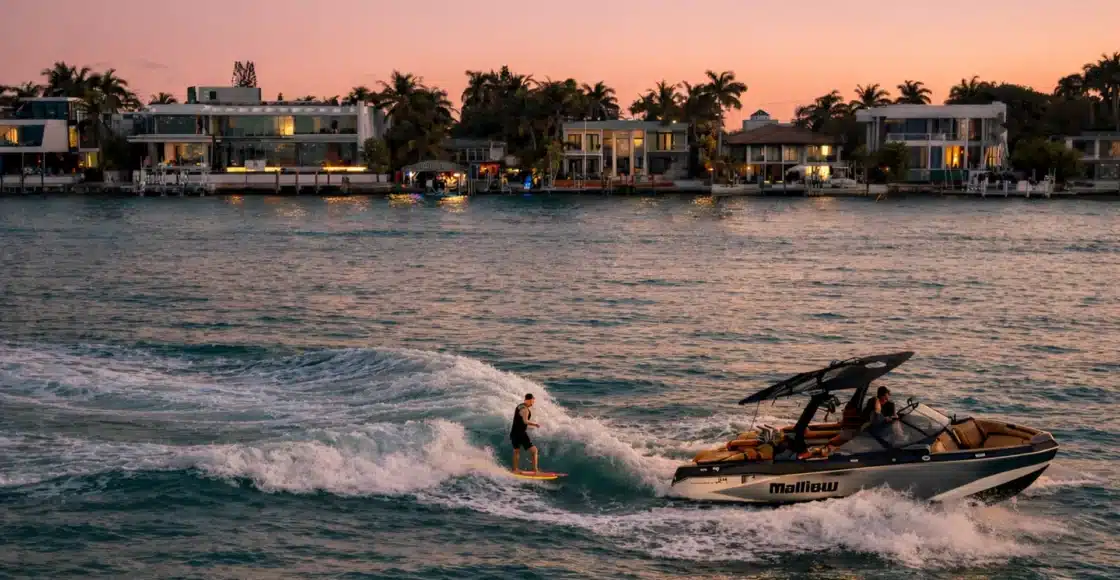
- Wakesurfing is the surprise easy win. The boat throws a waist-high wave, you ride just behind the transom at around 10 to 12 mph, and once you’re up you can drop the rope and surf the wake hands-free. Many first-timers stand up on their first or second try because the speed is low and the fall is soft.
- Wakeboarding takes a bit more. You start crouched in the water with the board perpendicular to the boat, let the pull bring you up slowly, and resist the urge to stand too early. Most people get up within a few attempts, then spend the rest of the day learning to carve edge to edge.
- Waterskiing on two combo skis is achievable in a session, but it demands leg strength and patience. Keep your knees bent, arms straight, and let the boat do the pulling. Slalom skiing on a single ski is a different animal and takes the most practice of any towed sport here, so save it for after you’ve mastered two skis.
If your group is mixed, start with tubing to warm everyone up, move to wakesurfing for the crowd-pleasing standups, then let the ambitious ones try wakeboarding or skiing while the wind is still down.
What water sports cost in Miami
Pricing depends mostly on whether you hire a captain and how big a boat you need. Ticket-per-ride operators look cheap until you multiply by a group of six. A private boat spreads the cost across everyone and gives you the whole day.
| Option | Typical price | Gear included | Best for |
|---|---|---|---|
| Captained water sports charter | $600–1,200 per half day | Often wakeboard, tube, ski, and life jackets | Beginners, groups, no license needed |
| Bareboat rental (you drive) | $350–800 per day | Varies by listing, confirm before booking | Licensed boaters wanting freedom |
| Dedicated wake boat with captain | $900–1,500 per half day | Surf board, wakeboard, ballast-equipped hull | Wakesurfing and serious wakeboarding |
| Jet ski / parasail ticket | $80–150 per ride | Provided on site | Quick single-activity thrills |
Prices vary with season, boat size, and captain experience (Boatsetter). Miami’s peak runs through the winter and spring, when demand and rates climb. Booking a few weeks out for a summer weekend usually lands a better price than a last-minute holiday reservation.
Safety, weather, and rules to know first
A few Florida rules and Miami-specific weather habits keep the day safe and legal.
- Life jackets. Everyone being towed on skis, a wakeboard, or a tube must wear a Coast Guard-approved life jacket. Florida also requires a proper personal flotation device aboard for every person on the boat (Florida FWC).
- You need a spotter. Florida law requires a second person aboard, besides the driver, to watch the person being towed, or a wide-angle rearview mirror where allowed. The observer must be at least a set minimum age to count (Florida FWC).
- Towing hours. Towing a skier or rider is restricted from a half hour after sunset to a half hour before sunrise. Plan to ride in daylight (Florida FWC).
- Time your day. Biscayne Bay is calmest in the early morning. Wind tends to build through the afternoon, chopping up the water and making learning harder. Book a morning charter if a beginner is riding.
- Watch hurricane season. Miami’s official hurricane season runs June 1 through November 30, and summer afternoons often bring fast-moving thunderstorms (NOAA). Check the forecast, and don’t fight a captain who calls it early for lightning.
Captains handle most of this for you, which is another reason beginners lean toward a charter. On a bareboat rental, the responsibility is yours, so confirm the boat has enough life jackets and a working mirror or plan for a spotter before you leave the dock.
Plan your Miami water sports day
Here’s how a good day comes together. Book a morning charter out of a Miami marina to catch the flat water on Biscayne Bay. Warm the group up with a few tubing runs, then rotate through wakesurfing and wakeboarding while the wind stays down. Anchor at the Haulover or Nixon sandbar for a swim and lunch when everyone needs a break, then squeeze in a last ski run before you head back.
For a first outing in Miami, Florida, a captained charter removes every barrier: no license, no gear to buy, and someone aboard who knows exactly where the calm water is that morning. When you’re ready, search Boatsetter for a Miami boat or captained charter that lists the towed-sports gear you want, message the captain to confirm the details, and lock in a morning slot.

Boatsetter empowers people to explore with confidence by showing them a world of possibility on the water. Rent a boat, list your boat, or become a Boatsetter captain today.
Frequently Asked Questions
Do you need a boating license to rent a boat for water sports in Miami?
It depends on when you were born. In Florida, anyone born on or after January 1, 1988 must complete an approved boating safety course to operate a motorboat of 10 horsepower or more. If you don't have that certification, booking a captained charter is the straightforward alternative — no license required.
What is the easiest towed water sport for a beginner in Miami?
Wakesurfing is generally the easiest entry point. The boat travels only 10 to 12 mph, the falls are soft, and many first-timers stand up on their first or second try. Tubing requires no skill at all, making it the go-to warm-up for kids or anyone nervous about getting in the water.
How much does a water sports boat charter cost in Miami?
A captained water sports charter typically runs $600–$1,200 per half day and usually includes a wakeboard, tube, skis, and life jackets for the group. A dedicated wake boat with a captain for wakesurfing runs closer to $900–$1,500 per half day. Booking a few weeks ahead for a summer weekend generally lands a better rate than a last-minute reservation.
What time of day is best for water sports on Biscayne Bay?
Morning is best. Biscayne Bay is calmest in the early hours before afternoon wind builds and chops the surface, which makes learning significantly harder. Beginners in particular should book a morning charter to get the flattest water of the day.
Your perfect day on the water is a few clicks away. Browse boats near you.
Find a Boat